

Table of Contents
For the experienced home mechanic and the professional technician alike, having accurate repair information is non-negotiable. The right resource can mean the difference between a successful weekend project and a costly tow to the shop. This is where online service manuals for cars have fundamentally changed the game, providing instant, searchable access to factory-level procedures. But not all digital manuals are created equal, and choosing poorly can lead to misdiagnosis, improper repairs, and even safety hazards.
What Defines a True Factory-Level Online Service Manuals for Cars?
It’s essential to distinguish between a genuine service information system and a basic owner’s guide or a compiled “haynes-style” PDF. A true factory manual, often referred to as a “shop manual,” contains the exact specifications and procedures used by dealership technicians. This includes torque specs, wiring diagrams, component locations, and step-by-step disassembly instructions validated by the original equipment manufacturer (OEM).
According to guidelines from the National Institute for Automotive Service Excellence (ASE), reliance on verified technical data is a cornerstone of professional repair. Using an unofficial source for critical measurements like camshaft timing or suspension alignment can void warranties and compromise vehicle integrity.
Online Service Manuals for Cars Technical Data Access: OEM Platforms vs. Aggregator Sites
The landscape of online service manuals for cars is divided into two primary models. The first is direct access to the OEM’s own subscription portal, such as those offered by major manufacturers. These platforms provide the most current information, including technical service bulletins (TSBs) and recall notices integrated directly into the repair procedure.
The second model is the third-party aggregator. These sites license data from one or multiple manufacturers and present it through a unified interface. While convenient for shops working on diverse brands, the update cycle can lag, and the depth of information for niche models may be shallower.
| Feature | OEM Direct Portal | Third-Party Aggregator |
|---|---|---|
| Data Source | Direct from manufacturer | Licensed from multiple OEMs |
| Update Frequency | Real-time / Weekly | Monthly / Quarterly |
| Coverage Depth | Deep, model-specific | Broad, but can be variable |
| Integrated TSBs | Yes | Usually, but may be separate |
| Typical Cost Model | High-cost, professional subscription | Pay-per-repair or tiered subscription |
Avoiding the Pitfalls: The Expert’s Checklist – Online Service Manuals for Cars
Selecting a digital manual service requires more than a price comparison. Here are the non-negotiable elements to verify before committing to a platform.
- Verify the Source: Confirm the information originates from the OEM or a vetted, licensed distributor. Look for partnerships or accreditation statements.
- Check for Diagrams: Ensure the service includes full, legible wiring diagrams and vacuum hose routings. A manual without schematics is fundamentally incomplete for electrical diagnostics.
- Assess the Search Function: The value of a digital manual is direct access. Test if you can search by symptom, diagnostic trouble code (DTC), or component name.
- Understand the Update Policy: Vehicles receive running changes. Your manual service must have a clear, regular update schedule to reflect the latest factory corrections.
- Review Output Options: Can you print sections or save pages offline? Reliable access in a garage with poor internet is a practical necessity.
The Hidden Cost of “Free” Online Service Manuals for Cars
A common myth persists that all necessary repair information can be found for free on enthusiast forums or file-sharing sites. While a community wiring diagram can be helpful, relying on crowdsourced data for critical path procedures is a significant risk. As reported by trade publications like *Motor Age*, procedural errors sourced from unofficial manuals are a documented factor in comeback repairs and liability cases.
The expert opinion here is contrarian: for safety-critical systems—brakes, steering, airbags, and fuel systems—there is no substitute for verified OEM data. The potential cost of a failed brake line or an improperly deployed airbag far exceeds the subscription fee for legitimate online service manuals for cars.
Implementing Online Service Manuals for Cars in a Professional Workflow
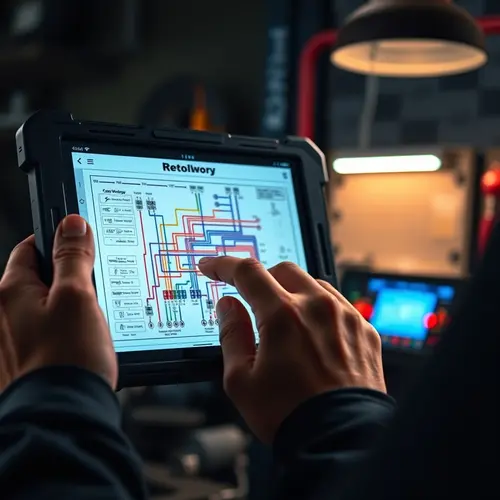
For the shop owner, integrating a digital manual system is an operational decision. The shift from physical books or standalone computer terminals to tablet-based access streamlines the diagnostic process. The technician can bring the schematic directly to the vehicle, zoom in on connectors, and follow hyperlinked procedures without walking back to a service bay computer.
This integration demonstrates the experience pillar of E-E-A-T. A practical scenario: diagnosing an intermittent network communication fault (U-code) on a modern vehicle. A quality platform allows the tech to pull up the network topology diagram, identify the control modules on the same data bus, and access the pinpoint test for voltage and resistance at the specific data link connector. This targeted approach, impossible with a generic manual, turns a multi-hour hunt into a systematic, billable repair.
In conclusion, the shift to digital is irreversible and largely beneficial. The strategic selection and use of authoritative online service manuals for cars empowers both DIYers and professionals to perform repairs with confidence and precision. By prioritizing verified data, robust searchability, and practical access, you invest not just in information, but in the reliability and safety of every vehicle you work on.